

Skip to content

Kinvent K-Push

by Kinvent
Original price $1,290.00 - Original price $1,290.00
Original price
$1,290.00
$1,290.00 - $1,290.00
Current price $1,290.00

✓ Authorized Kinvent Dealer
✓ Lowest Price Guaranteed
✓ FREE & FAST Shipping: In Stock and Ready to Ship
✓ Questions? Call an RFA Team Member: 1-855-864-6442

Handheld Dynamometer

Kinvent K-Push

K-Push reads isometric muscle strength through compression. The tester holds the sensor against the limb, the person pushes into the contact pad, and two flat 50 kg load cells convert that push into a force figure. Kinvent publish a range up to 90 kg with an accuracy of 0.1 kg, and state the sensor was validated against an Electroforce testing system.

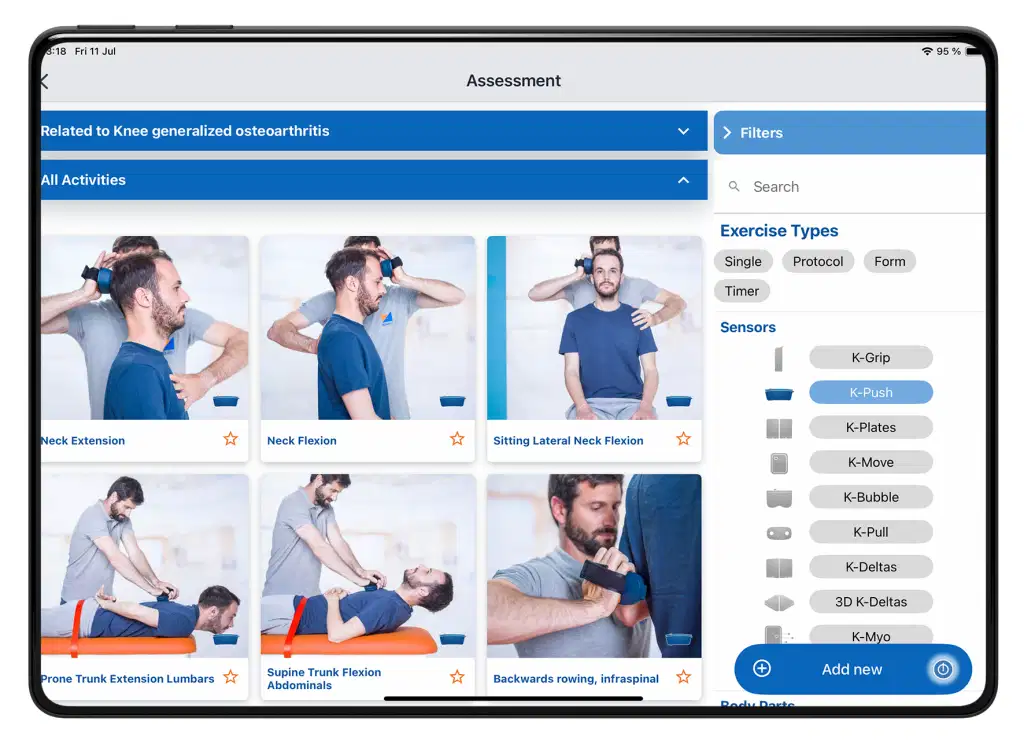
Force appears on the Kinvent app as the test runs, so peak force and average force over the effort are both on screen before the limb comes down. Heads attach magnetically to the pad and swap between positions, which is how Kinvent arrive at their figure of almost 40 muscle groups covered by the accessory range.

Range
Up to 90 kg
Published capacity
Accuracy
0.1 kg
As published by Kinvent
Load cells
2 × 50 kg
Flat cells behind the pad
Coverage
Almost 40
Muscle groups with the accessory range
Peak and average isometric force Magnetic swappable accessories Bluetooth to the Kinvent app Validated against Electroforce
Kinvent K-Push handheld dynamometer

Inside The Sensor

Two Load Cells Behind One Contact Pad

Compression is the whole mechanism here. Everything K-Push reports comes from what the pad feels while a limb presses into it.

⚖
Two flat 50 kg load cells
Kinvent describe the sensing element as two flat 50 kg load cells, and publish force measurement up to 90 kg with 0.1 kg accuracy. Flat cells sit directly behind the contact surface, so the figure comes from the same face the limb pushes against.
90 kg / 0.1 kg
🧲
Magnetic accessory mount
Heads swap on a magnetic attachment between tests. That is what lets one sensor body run a shoulder position, then a hip position, then an ankle position inside the same session without a tool or a screw thread.
Almost 40 muscle groups
📶
Bluetooth readout
The sensor sends its signal over Bluetooth to the Kinvent app, which Kinvent describe as real-time monitoring and reporting. The tester reads the effort as it happens rather than after the fact.
Real-time monitoring
📋
Electroforce comparison
Kinvent state that K-Push was validated against an Electroforce testing system for accuracy and consistency. That bench comparison is what sits behind the 90 kg and 0.1 kg figures quoted above.
Electroforce reference

What The App Reports

Numbers A Clinic Can Work From

K-Push is a measurement instrument. These are the quantities it puts in front of the tester, not an interpretation of them.

⏱
Average Force
Mean force across the hold
⇆
Left / Right Difference
Gap between sides, as a percentage
📱
Live Force Trace
Real-time monitoring during the effort
📋
Session Reports
Reporting through the Kinvent app
👥
Profile History
Results held against a person, test to test

Closer Look

How The Test Actually Runs

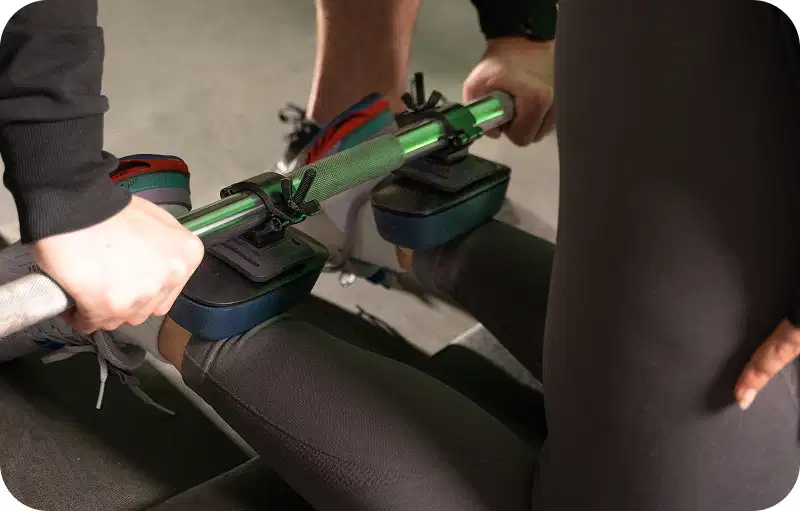
Kinvent K-Push held against a limb during an isometric strength test
The Push

Force Read Through Compression

The tester braces the sensor against the segment being tested and the person drives into it. Because the reading comes from compression at the pad, position and lever length are set by the tester, and the protocol you already use decides both.

  • Two flat 50 kg load cells sit behind the contact pad
  • Force measurement published up to 90 kg
  • Accuracy published at 0.1 kg
  • Peak force and average force from the same effort
  • Validated against an Electroforce testing system
Isometric 90 kg 0.1 kg
Kinvent K-Push in use with the Kinvent app
In The App

Peak, Average And The Gap Between Sides

Each effort produces a trace. The top of it is the peak, the sustained part of a hold gives the average, and running the same position on both limbs gives a percentage difference between them. Results attach to a profile, so the next session starts from the last one.

  • Peak force from the maximum of the effort
  • Average force across the hold
  • Percentage difference between left and right
  • Bluetooth link to a phone or tablet
  • Same app as every other Kinvent sensor
Real-time monitoring Bluetooth Kinvent app
Range of K-Push test positions across upper and lower body
Accessories

Heads Change, The Sensor Does Not

Kinvent put the coverage figure at almost 40 muscle groups when the accessory range is in use. The heads attach magnetically, so the change between a flat pad position and a contoured one happens in the gap between two tests rather than between two appointments.

  • Swappable accessories on a magnetic attachment
  • Almost 40 muscle groups across the accessory range
  • Upper and lower body positions from one sensor body
  • Ergonomic construction for handheld testing
Magnetic mount Swappable heads
K-Push used for strength testing in a sports setting
Portability

Testing That Travels To The Athlete

Kinvent describe K-Push as lightweight and built for quick strength assessments on the go. Nothing in the setup is fixed to a room: the sensor is handheld, the readout is a phone or tablet over Bluetooth, and the whole test happens wherever the athlete is standing.

  • Listed weight of 3.54 lbs
  • Listed dimensions of 10.83 x 5.19 x 6.69 in
  • Wireless connection, no cable to the readout
  • Same sensor for clinic, gym floor and field
3.54 lbs Handheld Wireless

Where It Gets Used

The Applications Kinvent List

These are the use cases Kinvent publish for K-Push, kept in their own terms.

💪
Muscle Strength Assessment
Quantifies muscle force and identifies deficits due to injury.
🏃
Rehabilitation & Sports Performance
Helps physiotherapists and trainers track progress and optimize training.
🔬
Clinical & Research Use
Provides precise force measurements for medical and biomechanical studies.

The Range

Pressed, Squeezed Or Pulled

All three run on the Kinvent app. What separates them is how force reaches the sensor.

Kinvent K-Grip
K-Grip
Grip dynamometer. Force arrives as a squeeze inside the hand.
Grip strength Handheld Kinvent app
Shop the K-Grip
You're Here
Kinvent K-Push
K-Push
Handheld dynamometer. Force arrives as compression into a pad the tester holds.
Isometric strength Almost 40 muscle groups Kinvent app
Currently viewing
Kinvent K-Pull
K-Pull
Traction dynamometer. Force arrives as tension along an anchored line.
Tensile force Anchored Kinvent app
Shop the K-Pull

Full Spec Sheet

Specifications

Measurement

Measurement type Isometric muscle strength, read through compression
Sensing element Two flat 50 kg load cells
Force range Up to 90 kg
Accuracy 0.1 kg
Values reported Peak force, average force
Validation Against an Electroforce testing system

Coverage & Accessories

Muscle groups Almost 40, with the accessory range
Accessory mount Magnetic attachment, swappable heads
Construction Handheld, ergonomic

Connectivity

Wireless Bluetooth
Software Kinvent app
App functions Real-time monitoring and reporting

Size & Weight

Listed weight 3.54 lbs
Listed dimensions 10.83 x 5.19 x 6.69 in
SKU 15-4342

Trusted & Certified

Kinvent's published certifications

These are the certifications and registrations Kinvent publish for their platform and their quality and information security systems. They cover the company and its medical device and data handling, not a performance claim about this sensor.

CE
CE Mark
European Union conformity
FDA
FDA
US Food and Drug Administration
HC
Health Canada
Medical device registration
13485
ISO 13485
Medical device quality management
9001
ISO 9001:2015
Quality management
27001
ISO 27001:2022
Information security management
HDS
HDS
French health data hosting
🔒
HIPAA
Healthcare privacy compliance

Who Uses Kinvent

Over 10,000 professionals and organizations

Kinvent name the following among the organizations working with their sensors. The list is theirs, published on their own product pages.

HSS
Hospital for Special Surgery
Orthopedics and sports medicine
MLB
Major League Baseball
Professional baseball
NFL
National Football League
Professional football
NBA
National Basketball Association
Professional basketball
MLS
Major League Soccer
Professional soccer
🎓
Stanford University
Collegiate athletics and research

Questions

Frequently Asked Questions

Isometric muscle strength, read as force pressed into the contact pad. Kinvent describe it as peak and average force assessment, so a single effort gives you the maximum the person reached and the force they held across the hold.
Kinvent publish force measurement up to 90 kg with 0.1 kg accuracy. The sensing element behind that figure is two flat 50 kg load cells sitting behind the contact surface.
Kinvent publish both figures in the same sentence: two flat 50 kg load cells, and force measurement up to 90 kg for the finished sensor. We quote them as published. Kinvent do not publish an explanation of how the cell rating relates to the assembly rating, and we are not going to invent one.
Kinvent state that K-Push was validated against an Electroforce testing system for accuracy and consistency. That is their statement and the basis for the 0.1 kg figure. They do not publish the test report itself, so we attach no further accuracy claim of our own to it.
Kinvent give the figure as almost 40 muscle groups when the accessory range is in use. The number that matters day to day is how many of your own test positions the head shapes cover, and the magnetic mount changes them between efforts rather than between sessions.
Over Bluetooth, to the Kinvent app. Kinvent describe the app side as real-time monitoring and reporting, so the tester can watch the force build during the effort instead of reading a single number afterwards.
Yes. Run the same position on both limbs and the app expresses the difference between the two efforts as a percentage. It is a measurement of what was recorded. What that gap means for a given athlete is the clinician's call, not the sensor's.
The listed weight is 3.54 lbs and the listed dimensions are 10.83 x 5.19 x 6.69 in. Those figures come from the product listing rather than from a Kinvent spec sheet, and they cover the sensor as listed. Accessories add to what you carry.
Kinvent do not publish a battery life or autonomy figure for K-Push, so we are not going to quote one. What they do publish about the power and connection side is that the sensor is wireless and runs over Bluetooth to the Kinvent app. If a runtime number matters to your buying decision, ask us and we will put the question to Kinvent rather than guess.
Kinvent publish no sampling rate for K-Push. The measurement figures they do publish are the 90 kg range, the 0.1 kg accuracy and the Electroforce validation. For work where sampling rate drives the protocol, treat it as an open question to confirm with Kinvent before you commit.
No warranty term is published on the Kinvent K-Push product page, so none is stated here. Contact us before ordering and we will confirm the current coverage in writing rather than have you rely on a number on a description page.
Kinvent do not publish a package contents list for K-Push. They publish that the accessories are swappable and magnetically attached and that the range covers almost 40 muscle groups, but not which heads ship with the sensor. Ask us to confirm the exact contents for the configuration you want.
Kinvent position it for physical therapists, trainers and clinicians who need precise muscle strength assessments, and list clinical and research use among the applications. It is a measurement instrument. The testing protocol comes from the professional holding it.
It does. Kinvent run one app across the sensor family, so a K-Push result sits alongside anything captured on the K-Grip, the K-Pull, the K-Bubble or the K-Force Plates.
Direction of loading. K-Push reads force pressed into a pad the tester holds, which puts the tester's own capacity in the load path. K-Pull reads force in tension along an anchored line, which takes the tester out of it. Clinics testing strong lower limbs often run both for that reason.


  • Measures: isometric muscle strength through compression
  • Measurement range: 90 kg as published by Kinvent
  • Accuracy: 0.1 kg as published by Kinvent
  • Load cells: two flat 50 kg cells; Kinvent publish this alongside the 90 kg range and give no explanation for the difference
  • Dimensions: 10.83 x 5.19 x 6.69 in
  • Weight: 3.54 lbs, sensor as listed
  • Connectivity: Bluetooth
  • App: K-Force app on a phone or tablet
  • What it records: peak force, average force over a timed hold, and left against right as a percentage difference
  • Measures: isometric muscle strength, read as force pressed into the contact pad
  • Sensing element: two flat 50 kg load cells sitting behind the pad
  • Published range: 90 kg, with accuracy stated at 0.1 kg
  • Parameters: peak force from the top of the curve, average force across a hold you set the length of
  • Side comparison: the app expresses the difference between left and right as a percentage
  • Accessory heads: change on a magnetic mount, with the accessory range reaching close to 40 muscle groups
  • Live trace: force draws on screen in the K-Force app while the effort is happening
  • Connection: Bluetooth to a phone or tablet, no cable and no base unit
  • Reference check: Kinvent state the sensor was validated against an Electroforce testing system
  • Who uses it: physiotherapists, rehabilitation clinics, sports medicine teams, strength and conditioning staff and researchers
  • 1 K-Push handheld dynamometer
  • Accessory heads: Kinvent describe a range of magnetically mounted heads for this sensor but do not itemise what ships in the box, so ask us before assuming a particular head is included