

Skip to content

Kinvent K- Force Plates

by Kinvent
Original price $2,990.00 - Original price $2,990.00
Original price
$2,990.00
$2,990.00 - $2,990.00
Current price $2,990.00

✓ Authorized Kinvent Dealer
✓ Lowest Price Guaranteed
✓ FREE & FAST Shipping: In Stock and Ready to Ship
✓ Questions? Call an RFA Team Member: 1-855-864-6442

Portable Force Plates

Kinvent K-Force Plates

A pair of portable platforms that measure vertical force under each foot and report how a load is shared between the two sides. Kinvent list a capacity of up to approximately 600 kg per platform, which is why the same pair records a quiet standing trial, a loaded squat and an isometric mid-thigh pull without swapping equipment.

The plates are listed at 11.02 lbs and 19.69 x 5.91 x 15.75 in, so they move between a treatment room, a gym floor, a field session and a lab. Everything they record reads live in the Kinvent app, and the app writes the assessment report from the recorded session.

Load capacity
600 kg
Per platform, approx.
Weight
11.02 lbs
As Kinvent list it
Dimensions
19.69"
x 5.91" x 15.75"
Game levels
10
Difficulty steps per game
Center of pressure Weight distribution Isometric testing Kinvent app
Kinvent K-Force Plates portable force plates

What The Plates Do

Four Jobs, One Pair Of Platforms

Kinvent group the plate protocols into balance work, dynamic movement, isometric strength and the software that records them.

🎯
Balance and postural control
Bilateral and single-leg stance assessed under static conditions, with center of pressure and CoP velocity reporting how accurately posture is controlled. The confidence ellipse puts a number on postural sway magnitude, and the Romberg test compares eyes open against eyes closed to expose visual dependency.
CoP, ellipse, Romberg
🏋️
Dynamic functional movement
Squats, sit-to-stand and single-leg squats for the lower body, the push-up force test for the upper body, and the Bridge Hamstrings Test for the posterior chain. Each returns force production and weight distribution, so a movement a clinician used to watch now comes back as a left-against-right split.
Up to 600 kg per plate
💪
Isometric strength testing
IMTP, the ASH Test, the Isometric Bridge and the McCall Test all run on the plates. Results come back as maximum strength, as relative strength normalized to body weight, and as a Limb Symmetry Index so asymmetry is read as a ratio rather than an impression.
IMTP, ASH, McCall
📊
Live feedback and reporting
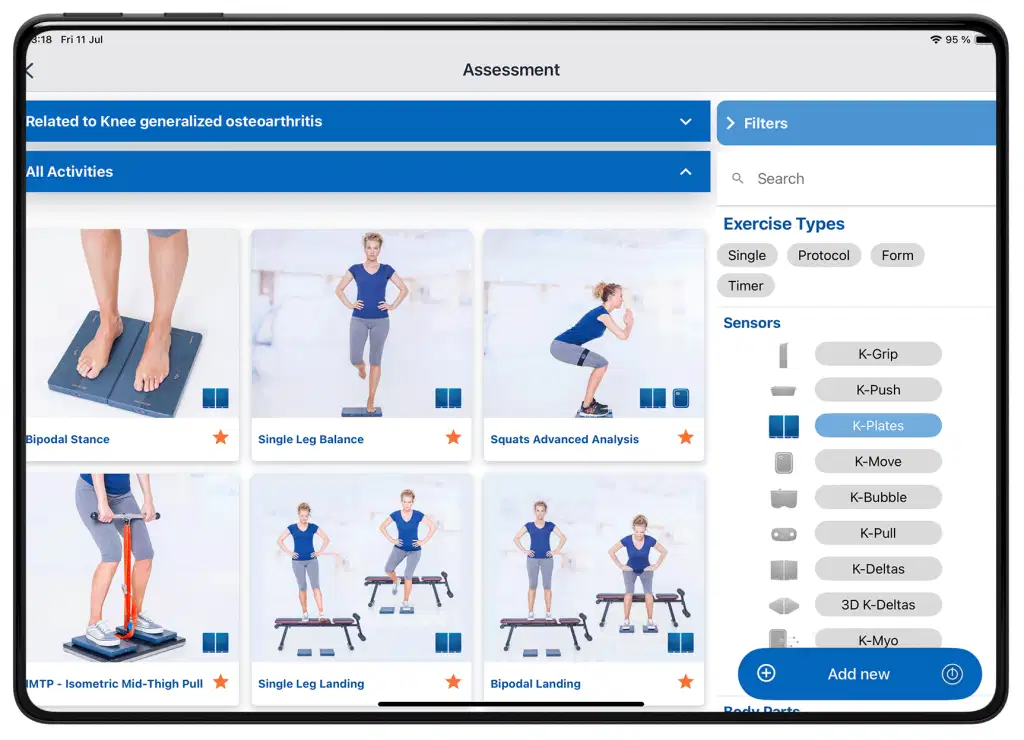
The Kinvent app carries real-time visualization and monitoring during the trial, then generates the assessment report automatically. The numbers on screen while the athlete is still on the plates are the numbers that land in the record, with no separate write-up step.
Automatic reports

What You Get Back

The Numbers The Plates Report

Every value below is one Kinvent name for this product. Where they publish no figure, this page says so rather than filling the gap.

➰
CoP Velocity
Speed of the pressure path
⭕
Confidence Ellipse
Postural sway magnitude
👁️
Romberg Coefficient
Eyes open against eyes closed
⚖️
Weight Distribution
Left to right and tips to heels
💥
Maximum Strength
Peak value for the test performed
⬇️
Ground Reaction Force
Instantaneous maximal value
↔️
Limb Symmetry Index
Asymmetry between the two sides
📐
Relative Strength
Normalized to body weight

Closer Look

Four Ways The Plates Get Used

Kinvent K-Force Plates set up for a standing balance assessment
Balance and posture

Standing trials, bilateral and single leg

One foot per platform gives the two-sided picture: the center of pressure path for the stance, the split between the tips and heels of the feet, and the percentage of body weight carried left against right. Stand on one leg and the same indicators come back for that side alone, which is what a return-to-sport conversation usually turns on.

  • Bilateral and single-leg balance under static conditions
  • Center of pressure and CoP velocity
  • Confidence ellipse for postural sway magnitude
  • Romberg test with eyes open and eyes closed
  • Landing stability after a controlled landing
Static balance Single leg Visual dependency
Range of movements assessed on the Kinvent K-Force Plates
Dynamic movement

Squats, sit-to-stand, push-ups and bridges

The capacity of roughly 600 kg per platform is what lets a loaded squat run on the same pair used for quiet stance. Force production and weight distribution are recorded through the movement, so a compensatory strategy that only appears under load has somewhere to show up.

  • Squats, sit-to-stand and single-leg squats
  • Push-up force test for the upper body
  • Bridge Hamstrings Test for force production and maintenance
  • Weight distribution read against the force of the movement
  • Approximately 600 kg capacity per platform
Loaded tasks Posterior chain Upper body
Isometric strength test performed on the Kinvent K-Force Plates
Isometric testing

IMTP and the isometric battery

Four named isometric protocols run on the plates: the Isometric Mid-Thigh Pull, the ASH Test, the Isometric Bridge and the McCall Test. Maximum strength on its own says little across a squad, so the app also returns relative strength normalized to body weight and a Limb Symmetry Index for the asymmetry between sides.

  • IMTP, Isometric Mid-Thigh Pull
  • ASH Test and Isometric Bridge
  • McCall Test
  • Limb Symmetry Index for asymmetry analysis
  • Relative strength normalized to body weight
Max strength LSI Relative strength
Kinvent K-Force Plates in use with the Kinvent app
App exercises

Games with a target taken from the assessment

The Kinvent app carries games driven by live plate data. Each one takes a target expressed as a percentage of the maximum recorded during that person's own evaluation, so the number on screen is scaled to them rather than to a generic standard. Every game carries ten difficulty steps to work through.

  • Target set as a percentage of the max evaluation
  • Ten levels of difficulty in every game
  • Proprioception exercises in bipedal and unipedal stance
  • Shoulder-loaded work on the plates
  • Run with or without belt straps for reduced weight loading
Live biofeedback Adjustable target Belt strap option

Where They Get Used

Six Jobs Kinvent Put The Plates To

Kinvent list clinics, rehabilitation centers, the field, gyms and laboratories as the settings, and physical therapists, sports performance staff, physicians, researchers and patients as the users.

🛡️
Injury prevention
Screening balance, force production and side-to-side distribution before a problem shows up in training.
🩺
Rehabilitation monitoring
Repeating the same protocol through a rehab block so progress is a number rather than a judgement call.
🔁
Return-to-sport decisions
Single-leg trials, landing stability and the Limb Symmetry Index give the discharge conversation something to sit on.
🏆
Sports performance testing
IMTP and the rest of the isometric battery, with relative strength normalized to body weight for squad comparison.
🔋
Neuromuscular fatigue detection
Kinvent list fatigue detection among the applications, read against that athlete's own recorded baseline.
⚖️
Asymmetry identification
Asymmetry and imbalance analysis, plus tracking of the compensatory strategies an athlete falls back on.

The Kinvent Lineup

Three Force Plate Systems

Kinvent build three plate systems. The differences below are the ones they publish, nothing more.

You're Here
Kinvent K-Force Plates
K-Force Plates
Portable vertical force plates for balance, functional movement and isometric testing.
Portable, 11.02 lbs Approx. 600 kg per platform Center of pressure and Romberg IMTP and isometric battery
Currently viewing
Kinvent K-Deltas
K-Deltas
Larger-surface plates for dynamic force, symmetry and jump analysis.
Large plate surface Jump analysis Symmetry analysis
Shop the K-Deltas
Kinvent 3D Deltas
3D Deltas
Multi-axis force capture for postural and gait analysis.
Multi-axis force capture Gait analysis Postural analysis
Shop the 3D Deltas

Full Spec Sheet

Specifications

Platform

Load capacity Up to approx. 600 kg per platform
Measurement Vertical force
Dimensions 19.69" x 5.91" x 15.75"
Weight 11.02 lbs

Software & Compatibility

App Kinvent app
During the trial Real-time visualization and monitoring
Reporting Automatic report generation
Compatible sensors K-Push, K-Pull, K-Power, K-Myo, K-Move
Game difficulty levels 10 per game

Protocols

Balance Bilateral, single leg, Romberg, landing stability
Functional Squat, sit-to-stand, single-leg squat, push-up, Bridge Hamstrings
Isometric IMTP, ASH Test, Isometric Bridge, McCall Test
Outputs CoP, CoP velocity, confidence ellipse, LSI, relative strength

Not Published By Kinvent

Sampling frequency Not published
Accuracy figure Not published
Battery life Not published
Warranty term Not published

Trusted & Certified

Kinvent's published certifications

These are the certifications and registrations Kinvent publish for their platform and their quality and information security systems. They cover the company and its medical device and data handling, not a performance claim about this sensor.

CE
CE Mark
European Union conformity
FDA
FDA
US Food and Drug Administration
HC
Health Canada
Medical device registration
13485
ISO 13485
Medical device quality management
9001
ISO 9001:2015
Quality management
27001
ISO 27001:2022
Information security management
HDS
HDS
French health data hosting
🔒
HIPAA
Healthcare privacy compliance

Who Uses Kinvent

Over 10,000 professionals and organizations

Kinvent name the following among the organizations working with their sensors. The list is theirs, published on their own product pages.

HSS
Hospital for Special Surgery
Orthopedics and sports medicine
MLB
Major League Baseball
Professional baseball
NFL
National Football League
Professional football
NBA
National Basketball Association
Professional basketball
MLS
Major League Soccer
Professional soccer
🎓
Stanford University
Collegiate athletics and research

Questions

Frequently Asked Questions

Vertical force under each foot, and everything Kinvent derive from it. That includes center of pressure and CoP velocity, the confidence ellipse for postural sway magnitude, the Romberg ratio, maximum strength, weight distribution, relative strength normalized to body weight and the Limb Symmetry Index. All of it reads in the Kinvent app.
Kinvent publish a capacity of up to approximately 600 kg per platform. That is why the same pair handles a quiet standing trial and a loaded squat without swapping equipment. Kinvent give the number as an approximation and we publish it that way.
The listing gives 19.69" x 5.91" x 15.75" and 11.02 lbs. Kinvent do not state whether that mass covers one platform or the pair, so treat it as the figure they publish and confirm with us before planning a shipping weight around it.
No. Kinvent describe the plates as offering clinical accuracy and reproducibility, but they publish no sampling frequency and no measurement accuracy figure for this product. We will not quote a number they have not stated, and any figure published for the larger K-Deltas platforms belongs to that product alone. If you need a sampling rate in writing for a research protocol, ask us and we will put the question to Kinvent.
Kinvent name bilateral and single-leg balance under static conditions, the Romberg test with eyes open and eyes closed for visual dependency, center of pressure and CoP velocity, the confidence ellipse and landing stability, which evaluates the ability to absorb force and regain a stable posture after a controlled landing.
Yes. Kinvent list four isometric protocols on the plates: the IMTP (Isometric Mid-Thigh Pull), the ASH Test, the Isometric Bridge and the McCall Test. Output includes maximum strength, relative strength normalized to body weight, and Limb Symmetry Index asymmetry analysis.
Kinvent name squats, sit-to-stand and single-leg squats for the lower body, a push-up force test for the upper body, and the Bridge Hamstrings Test for the posterior chain, which assesses force production and force maintenance during a dynamic task. Force production and weight distribution are recorded for each.
Each game is driven by live plate data and aimed at a target. The target is set as a percentage of the maximum recorded during the evaluation, so it is scaled to that individual's own result, and each game carries ten levels of difficulty. These are software features of the Kinvent app.
Plate work can be run with or without belt straps, the strapped version being for reduced weight loading. Both variants are recorded through the same plates and read in the same app.
The Kinvent app does. It carries real-time visualization and monitoring during the trial and automatic generation of your reports and assessments afterwards. What appears on screen while the athlete is on the plates is the same data that ends up in the record.
Yes. Kinvent list compatibility with K-Push, K-Pull, K-Power, K-Myo and K-Move, all running through the Kinvent app. One session can therefore hold a plate trial and a K-Push or K-Move measurement under the same profile.
Kinvent list force plate frames as their own item, both standalone and in a version supplied with K-Force Plates. They publish no package contents list for the plates themselves, so we do not state what ships in the box. Ask us before ordering if you need the frames included and we will confirm the configuration.
Kinvent name physical therapists, sports performance professionals, physicians, researchers and patients as the users, across clinics, rehabilitation centers, the field, gyms and laboratories. The portability is the reason the same pair covers more than one of those settings.
The K-Force Plates are the portable, vertical-force option, built around balance, functional movement and isometric testing. The K-Deltas use a larger plate surface for dynamic force, symmetry and jump analysis, and the 3D Deltas capture force on multiple axes for postural and gait analysis. Those are the differences Kinvent publish, so those are the only ones stated here.
Kinvent publish CE marking, FDA registration, ISO 13485, ISO 9001:2015, ISO 27001:2022, HDS and HIPAA compliance at company and platform level. Those cover the company, its medical device quality system and its data handling. They are not a performance claim about these plates, and for class or registration questions in your territory, contact Kinvent or ask us and we will put the question to them in writing.
  • Measures: centre of pressure, weight distribution and instantaneous maximal ground reaction force
  • Load capacity: approximately 600 kg per platform, as Kinvent state it
  • Sampling rate: Kinvent publish no sampling frequency or measurement resolution for this product
  • Dimensions: 19.69 x 5.91 x 15.75 in
  • Weight: 11.02 lbs; Kinvent do not state whether that figure covers one platform or the pair
  • Game levels: 10 difficulty steps in each game
  • App: K-Force app, with live visualisation and automatic report generation
  • What it records: centre of pressure path, Romberg coefficient, confidence ellipse, tips and heels distribution, left and right load share
  • Measures: centre of pressure, weight distribution and ground reaction force under the feet
  • Centre of pressure: traced across a stance trial and summarised with a confidence ellipse
  • Postural indicators: Romberg coefficient, confidence ellipse, maximum strength and weight distribution
  • Distribution: average over a trial, tips against heels within the foot, and left against right
  • Stance modes: bipedal and unipedal analysis, one foot per platform or both on one plate
  • Loaded movement: squats and push-ups analysed for left and right share against the force of the movement
  • Games: targets set as a percentage of the person's maximum evaluation, with ten difficulty levels in each
  • Belt straps: plate work listed with or without straps for reduced weight loading
  • Reporting: values appear live during the trial and the app generates the assessment report
  • Ecosystem: Kinvent list compatibility with K-Push, K-Pull, K-Power, K-Myo and K-Move on the K-Force app
  • K-Force Plates, supplied as a pair of platforms
  • Accessories: Kinvent publish no itemised parts list for this listing, so ask us before assuming a frame or strap is in the box